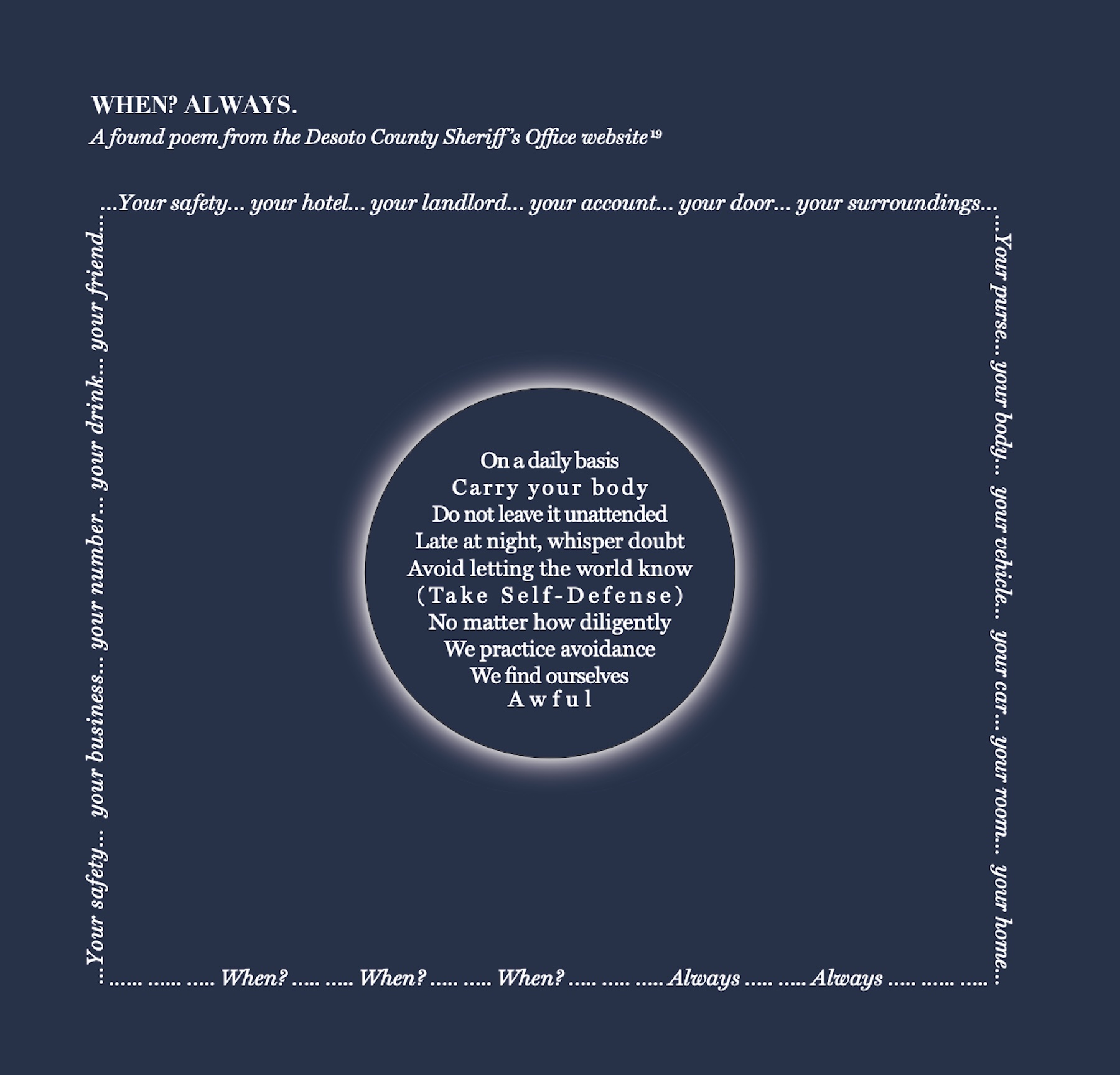
WHEN? ALWAYS. A found poem from the Desoto County Sheriff's Office website. The center text reads: On a daily basis, Carry your body, Do not leave it unattended, Late at night whisper doubt, Avoid letting the world know, Take Self-Defense, No matter how diligently, We practice avoidance, We find ourselves, Awful.
About This Poem
'When? Always.' is a found poem extracted from a sheriff office website's safety tips for women. It is a companion to the visual poem 'Safety Points.' The title, taken from the repetitive instructions, underscores the constant vigilance required from women just to be safe. The words running around the page's borders literally "box in" the central idea — that women, not the societal structures that endanger them or perpetrators, are responsible for preventing assault.
The dark, sparse space of the work contrasts the busy black and white text wall of the companion poem, 'Safety Points.' The central circle (or point) with a halo is reminiscent of a moon. Together with the dark blue background, this visual acknowledges the "late at night" line of the poem, and the isolating impact of women being held solely responsible for their survival and safety: "your safety… your business… your hotel…".
Explore the Data
"When? Always." documents the unending inventory of safety modifications women make — not as a choice, but as a precondition of moving through the world. These numbers quantify that calculus.
Data year: 2018
Behavior women adopt for safety
% who do this
Avoid walking alone at night
81%
Cross the street to avoid a man
71%
Check back seat before entering car
68%
Text someone when meeting a stranger
61%
Hold keys as improvised weapon
54%
Share live location when out alone
53%
Source: Stop Street Harassment, "The Facts Behind the #MeToo Movement," 2018; YouGov/Plan International survey on street harassment, 2018.
By comparison, 18% of men report similar behavioral modifications due to safety concerns.
Data year: 2018
Type of harassment experienced (lifetime)
% of US women
Any form of sexual harassment
81%
Verbal harassment in public
77%
Unwelcome physical contact
51%
Followed by a stranger
34%
Prevented from using public spaces
38%
Source: Stop Street Harassment, "Unsafe and Harassed in Public Spaces: A National Street Harassment Report," 2018.
38% of women say fear of sexual harassment or violence prevents them from using public spaces they would otherwise use.
Data year: 2022
Group
% feel unsafe walking alone at night near home
Men
19%
Women
45%
Women ages 18–34
58%
Source: Gallup, "Crime," annual poll, 2022.
The "fear gap" — women's significantly higher fear of crime — is documented across cultures and decades, regardless of whether women's victimization rates match that fear.
More Resources
Stop Street Harassment — Research, data, and advocacy on sexual harassment in public spaces.
About This Poem
'When? Always.' is a found poem extracted from a sheriff office website's safety tips for women. It is a companion to the visual poem 'Safety Points.' The title, taken from the repetitive instructions, underscores the constant vigilance required from women just to be safe. The words running around the page's borders literally "box in" the central idea — that women, not the societal structures that endanger them or perpetrators, are responsible for preventing assault.
The dark, sparse space of the work contrasts the busy black and white text wall of the companion poem, 'Safety Points.' The central circle (or point) with a halo is reminiscent of a moon. Together with the dark blue background, this visual acknowledges the "late at night" line of the poem, and the isolating impact of women being held solely responsible for their survival and safety: "your safety… your business… your hotel…".